


Your business card gets judged before you say a word. Someone takes it, feels the weight, glances at the finish, and forms an opinion about your business in about two seconds. That is a lot of pressure for a 3.5 by 2 inch rectangle, which is exactly why the paper and finish choices matter as much as the design.
Here is what business card printing actually costs, what the paper options mean in plain English, and how to get cards that feel as good as they look.
The Short Answer: What Business Cards Typically Cost
Prices vary by market and shop, so treat these as typical ranges, not quotes:
- 250 cards, standard stock: usually the pricey-per-card option, since setup costs spread across fewer cards
- 500 cards, standard 14pt stock: often in the $20 to $35 range, the most common order
- 500 cards, premium 16pt stock: often in the $35 to $50 range
- 1,000 cards: the sweet spot where per-card cost drops sharply, often 40 to 60 percent less per card than small runs
- Specialty finishes (foil, spot UV, painted edges): add roughly $10 to $25 or more per order depending on complexity
The pattern: the first few hundred cards carry the setup cost, and everything after that gets cheaper fast. Which brings us to the math nobody explains.
What Actually Drives the Price
Four things decide what you pay:
1. Quantity. The biggest lever. Printing 1,000 instead of 250 rarely doubles the price, because the expensive part (setup, plates, calibration) happens once.
2. Paper stock. Thicker and specialty stocks cost more. The jump from standard to premium is modest. The jump to luxury thickness is real.
3. Finishes. A plain matte card and the same card with foil stamping and spot UV are different products with different prices. Each special process adds a step.
4. Turnaround. Standard turnaround is the baseline. Need them tomorrow? See our guide to rush printing in Katy for what is realistic and how rush fees work.
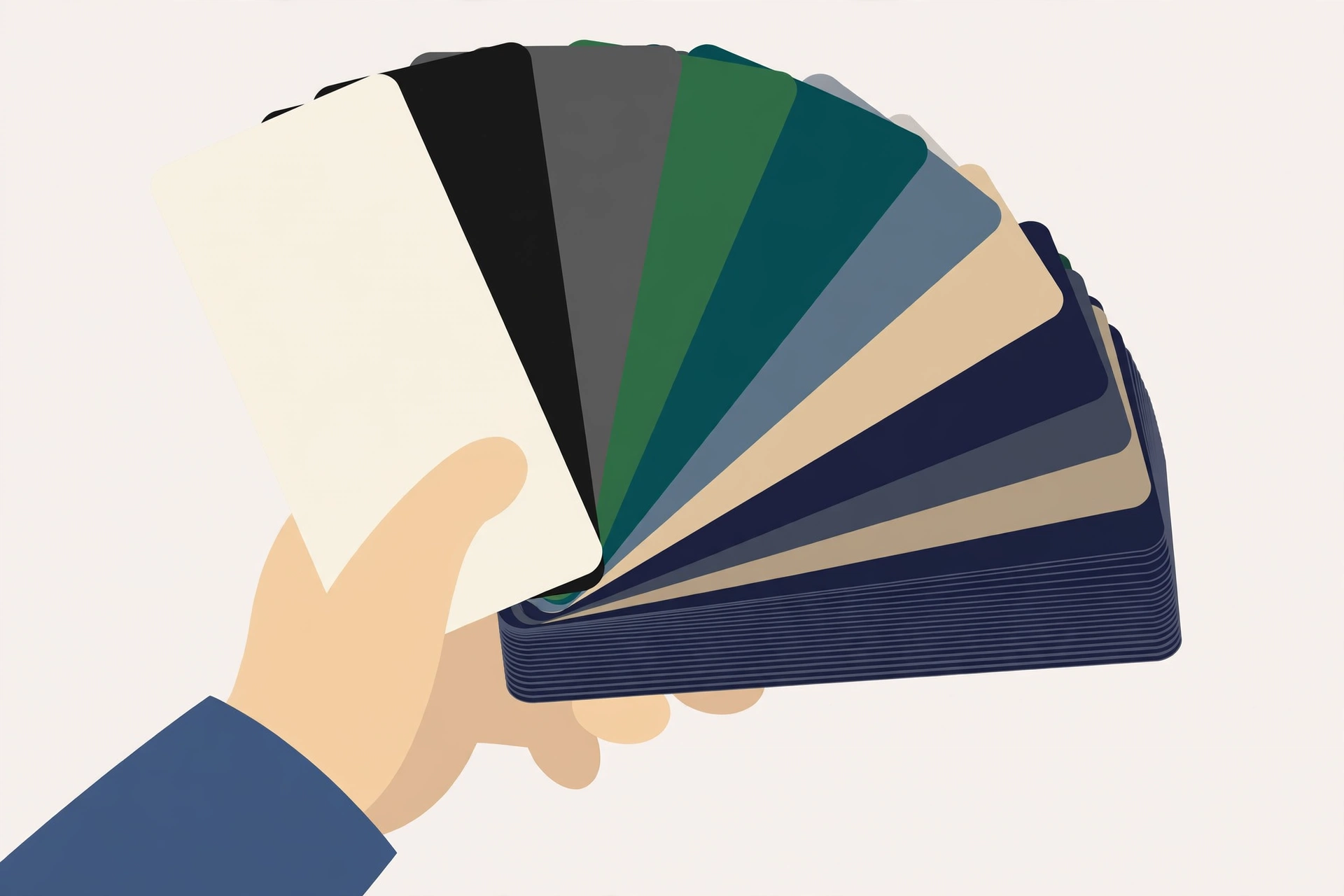
Paper Stocks Explained in Plain English
Card stock is measured in points (pt), where one point is one-thousandth of an inch. Bigger number, thicker card. Here is what you are choosing between:
| Stock | What it feels like | Best for |
|---|---|---|
| 14pt standard | Solid and familiar, the classic business card | Everyday networking, high-volume handouts |
| 16pt premium | Noticeably thicker, substantial in hand | Making an impression without going overboard |
| 18pt and up | Luxury thickness, people comment on it | Premium brands, designers, executives |
| 32pt ultra-thick | Feels like a credit card, unforgettable | Maximum impact, small quantities |
| Uncoated / recycled | Natural texture, writable surface | Eco brands, creatives, anyone who hand-writes notes on cards |
The honest guidance: 14pt is perfectly respectable and nobody will judge you for it. 16pt is where cards start to feel premium for a small price bump. Beyond that, you are paying for the reaction, which is a legitimate business decision.
One more thing no screen can tell you: feel the paper before you commit. Stocks that look identical online feel completely different in hand. This is the single biggest advantage of ordering from a local shop, and it is free.
Finishes That Make Cards Feel Expensive
The finish is the coating or treatment on the card surface. It changes both the look and the feel:
Matte laminate: Smooth, glare-free, sophisticated. Fingerprints do not show. The modern default for premium cards.
Gloss laminate: Shiny and vibrant, colors pop. Shows fingerprints, can feel less premium than matte to some hands.
Soft-touch (suede) laminate: Velvety texture that people cannot stop touching. The finish most likely to make someone say "nice card."
Spot UV: Glossy coating applied only to specific areas, like your logo, against a matte background. Creates contrast and depth that catches light as the card moves.
Foil stamping: Metallic gold, silver, copper, or holographic foil pressed into the card. Unmistakable luxury signal.
Rounded corners: A small detail with outsized effect. Softens the card and stands out in a stack of sharp rectangles.
Painted edges: Color applied to the edge of a thick card. Visible from the side, distinctive in a way people remember.
You do not need all of these. One well-chosen finish on the right stock beats three finishes fighting each other. When in doubt, ask to see samples. Any good shop has them.
The Quantity Math Nobody Tells You
Here is the open secret of card pricing: the jump from 250 to 500 cards is small, and the jump from 500 to 1,000 is where the real value lives. Setup, calibration, and press time are mostly fixed costs. Once the press is running, printing more cards is cheap.
Practical rules:
- If you will use 300 cards this year, order 500. The price difference is small and running out mid-year costs more.
- If you hand out cards regularly, 1,000 is usually the sweet spot for per-card cost.
- Do not order 5,000 "to save money" if your phone number might change. Outdated cards are the most expensive cards.
- For a new business still finalizing branding, order a small run first, then commit to volume once the design is settled.
Local Print Shop vs Online: The Honest Tradeoff
Online printers are often cheaper per card, especially at volume. That is real and worth acknowledging. Here is what the per-card price does not include:
Touching the paper first. Online, you guess. Locally, you feel 14pt vs 16pt vs soft-touch before spending a dollar.
A human catching your typo. Nobody wants to discover a wrong phone number on 1,000 cards. A counter review catches what tired eyes miss at midnight.
Proof approval in person. See the actual colors and layout before it prints, not a screen approximation.
Turnaround you can count on. When you need cards this week, a local shop beats a shipping estimate every time.
No shipping cost or wait. Especially for small runs, shipping can erase the online price advantage entirely.
The right choice depends on your situation. Huge run, simple design, no rush: online can make sense. Anything else: the local advantages usually win on total value, not just price.
Send the Right File the First Time
Bad files are the number one cause of disappointing cards and delayed orders. Send this:
- PDF format, the universal print-ready container
- 300 DPI resolution at full size (no screenshots, no web images)
- CMYK color mode, not RGB (screens and presses speak different color languages)
- Bleed of 1/8 inch on all sides, so edge-to-edge color does not leave white slivers
- Fonts embedded or outlined, so your typography does not get substituted
- The standard size: 3.5 by 2 inches, plus bleed
Do not have a print-ready file? Bring what you have. Our design services can build or fix your card layout, and it is far cheaper than reprinting 500 cards with a mistake.
Frequently Asked Questions
How much does it cost to print 500 business cards?
Typically $20 to $35 for standard 14pt stock and $35 to $50 for premium 16pt, though prices vary by market. Specialty finishes add to the cost. Ordering 1,000 usually drops the per-card price significantly.
What is the best paper for business cards?
For most people, 16pt with a matte or soft-touch finish hits the sweet spot of premium feel and reasonable price. 14pt is fine for high-volume handouts. Go thicker when the card needs to impress.
What is 16pt vs 14pt business card stock?
Points measure thickness in thousandths of an inch. 16pt is about 15 percent thicker than 14pt, which you can genuinely feel. It is the most common upgrade and one of the cheapest ways to make cards feel premium.
Are glossy or matte business cards better?
Neither is objectively better. Matte looks modern and hides fingerprints. Gloss makes colors pop. Soft-touch laminate, a velvety matte variant, is the current favorite for premium feel. Feel samples before deciding.
How long does business card printing take?
Standard orders typically take a few business days. Same-day is often possible with a print-ready file. Specialty finishes add days. See our rush printing guide for realistic timelines.
Can I print business cards same day?
Often yes, for standard stocks and finishes with a clean file ordered early in the day. Call ahead to confirm the schedule.
Feel It Before You Print It
Business cards are one of the few marketing materials people physically touch, which makes the stock and finish decision disproportionately important. Get those right and the design almost takes care of itself.
Stop by Print N Ship 4u in Katy, TX and feel the difference between stocks before you order. We will show you samples, review your file for free, and print cards you will be proud to hand out. Call (281) 375-9714 or visit the shop.