


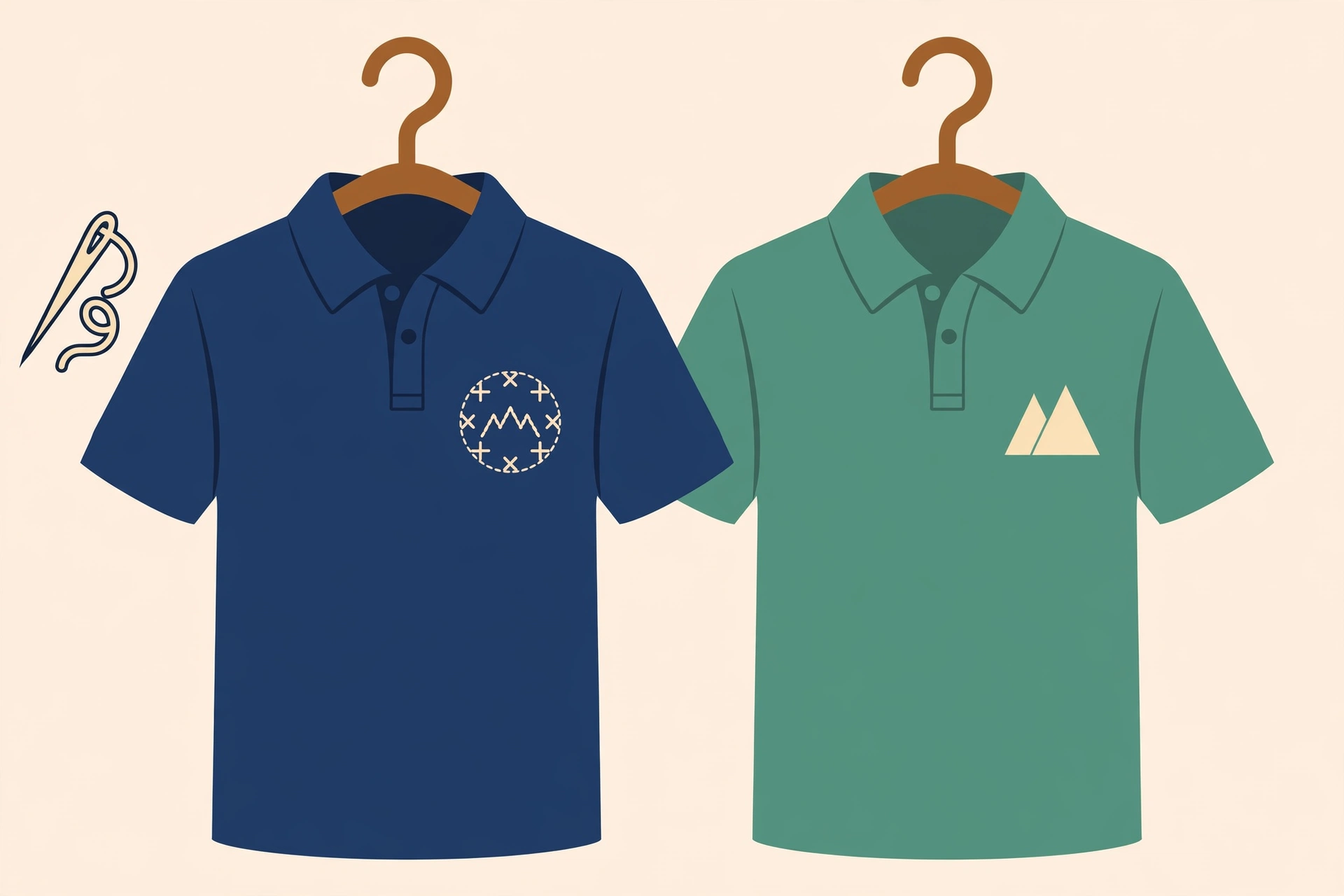
The polo shirt is the unofficial uniform of American business. Real estate teams, service crews, office staff, restaurant teams, event volunteers, everyone wears them. But when it is time to add your logo, you hit a real fork in the road: embroidered vs printed polo shirts. The choice changes how the shirt looks, how long it lasts, and what you pay.
Both can look fantastic. They just look fantastic in different ways, and the right pick depends on your logo, your quantity, and how hard those shirts will work. Here is the full breakdown from a shop that decorates polos every week.
The 30-Second Answer
Choose embroidery when the shirts need to look premium and last for years: client-facing staff, uniforms washed weekly, simple logos. It costs a bit more but reads as quality.
Choose printing when the design is colorful or detailed, the shirts are for events or seasonal staff, or you need a bigger bolder design. It is more flexible and usually cheaper at quantity.
| Embroidery | Printing | |
|---|---|---|
| Look | Raised, textured, premium | Flat, smooth, vibrant |
| Detail | Simple logos and text | Full color, gradients, tiny text |
| Durability | Excellent, thread outlasts the shirt | Very good with proper wash care |
| Pricing | By stitch count, plus a one-time digitizing fee | By colors, size, and quantity |
| Best for | Uniforms, corporate, client-facing | Events, teams, bold designs |
What Embroidery Gives You
Embroidery stitches your logo directly into the fabric with thread. The result has dimension you can feel, catches the light, and carries a weight people associate with quality. This is why it dominates professional settings. When the shirt needs to say established and trustworthy, embroidery is the default.
It is also the durability king. Thread does not crack, peel, or fade. An embroidered logo typically looks good for the entire life of the shirt, which matters when uniforms get washed every single week.
How embroidery pricing actually works
Two things drive the price. First, stitch count: bigger and more complex designs need more stitches, and you pay for them. A standard left chest logo is the sweet spot. Go large and the price climbs fast.
Second, the digitizing fee. Your logo cannot go straight into an embroidery machine. It has to be converted into a stitch file by a digitizer, a one-time setup, usually a modest flat fee. Once it is digitized, that file is yours and reorders skip the fee entirely. This is why a first order of six embroidered polos feels pricey per shirt, and the reorder feels like a bargain.
The limits
Embroidery struggles with tiny text, fine detail, and gradients. A photographic logo or hairline lettering will need simplifying to stitch cleanly. And on very lightweight or stretchy polos, dense embroidery can pucker the fabric slightly, which is why an experienced shop adjusts stabilizer and density for the garment.
What Printing Gives You
Printing puts your design on the fabric surface, usually by screen printing or DTF (direct to film) on polos. The result is flat, smooth, and capable of things thread cannot do.
Full color, gradients, shading, photographic detail, tiny text: all fine, with zero simplification of your logo. If brand accuracy matters and your logo has elements that would get lost in thread, printing reproduces it exactly.
Printing also scales to larger designs easily. A bold design across the chest or a full back print is affordable in print. The same thing in embroidery would be heavy, stiff, and expensive.
The tradeoff is perception and feel. A print sits on the fabric, and on a polo, which people expect to look polished, a large print can read more casual than embroidery. For a startup, an event crew, or a sports league, that is often exactly the vibe. For a law office, it can miss the mark.
Durability in Real Life
Work shirts get washed constantly, so let us be practical.
Embroidery wins on pure longevity. It does not crack or peel, and quality stitching looks nearly new after years of washing. The shirt fabric usually gives out before the logo does.
Printing is durable too but asks a little more of you. A quality screen print or DTF print holds up through many wash cycles, but hot dryers and bleach break it down faster than thread. Washing inside out in cold water makes a real difference.
One fabric note: polos are usually pique knit, which has a subtle texture. Embroidery sits beautifully on it. Prints can show slight unevenness up close on textured knits, while on smooth performance polos both methods look clean.
Cost Compared: Three Real Order Scenarios
Pricing varies by shop and region, so treat these as typical ranges, not quotes:
12 polos, left chest logo. Embroidery often runs a bit more per shirt here because the digitizing fee spreads across only twelve pieces. A simple one-color print is usually the cheapest option at this quantity.
48 polos, left chest logo. The digitizing fee fades into the background and embroidery becomes very competitive per shirt. A full-color printed logo at this quantity is also attractively priced, especially in DTF.
144 polos, mixed. At real volume, screen printing pulls ahead on per-shirt cost for printed designs, while embroidery pricing stays steadier. This is the quantity where getting both quotes side by side pays off most.
The honest rule: under about two dozen shirts with a simple design, printing is usually cheaper. At higher quantities, the gap narrows and the decision becomes about look and durability more than price.
The Combo Move Most Businesses Miss
You do not have to pick one method for the whole shirt. One of the most popular setups we do is an embroidered left chest logo for the professional touch, plus a printed design on the back or sleeve for events and visibility. Office staff get polish from the front, and the team still gets the bold branding from behind at the company picnic.
Different roles can also get different treatments: embroidered polos for the office team, printed tees for the field crew. Same logo, right method for each job.
How to Send Your Logo So It Comes Out Right
A quick file guide that saves everyone time:
- For embroidery: a clean vector file or high-resolution image works. The digitizer redraws your logo as stitches, so tiny text under about a quarter inch tall may need enlarging or simplifying. Tell the shop if your logo has fine detail so expectations are set before the machine runs.
- For printing: a PNG with transparent background at 300 DPI at print size, or vector if you have it. What you send is what prints, so a crisp file matters more here than with embroidery.
- For both: the exact thread or ink colors can be matched to your brand. If you have Pantone or hex values, send them.
Turnaround: Which Is Faster?
For repeat orders, both are quick. For a first embroidery order, budget a few extra days: the digitizing has to be done and usually a sample gets sewn for approval before the full run. Printing skips that step, so first-time print orders often ship faster. If you are on a tight deadline for a first order, mention it upfront. Shops can often rush digitizing, but it helps to ask early.
Frequently Asked Questions
Do embroidered logos last longer than printed ones?
Generally, yes. Embroidery does not crack, peel, or fade, and it typically outlasts the shirt itself. Quality printing is durable too, but it needs a bit more wash care to stay looking new.
Is embroidery better on polo shirts?
For a premium, professional look on polos, embroidery is the most popular choice and the one most associated with business apparel. For colorful or detailed artwork, printing does the better job.
How much does it cost per shirt to embroider vs print a polo?
It depends on design size, complexity, and quantity. As a rough guide, a standard left chest embroidery often costs a few dollars more per shirt than a simple one-color print at small quantities, and the gap narrows as quantity grows. Get both quoted with your actual logo for the real number.
Can you embroider moisture-wicking performance polos?
Yes, and it is very common for golf and outdoor teams. Performance fabrics need the right stabilizer and a lighter stitch density so the fabric does not pucker. Mention the fabric type when you order so the embroiderer sets up correctly.
What is the minimum order for embroidered polos?
Most shops can embroider a single shirt. The per-shirt price is simply better at quantity because the one-time digitizing fee spreads across more pieces.
Let's Look at Your Logo
The fastest way to decide is to put your actual logo in front of someone who does both methods daily. Bring it to Print N Ship 4u in Katy, TX, and we will show you what it looks like embroidered versus printed, quote both honestly, and tell you which one fits your team, your timeline, and your budget. We decorate polos, tees, hats, and more for businesses all over the Houston area. Call (281) 375-9714 or stop by the shop.