


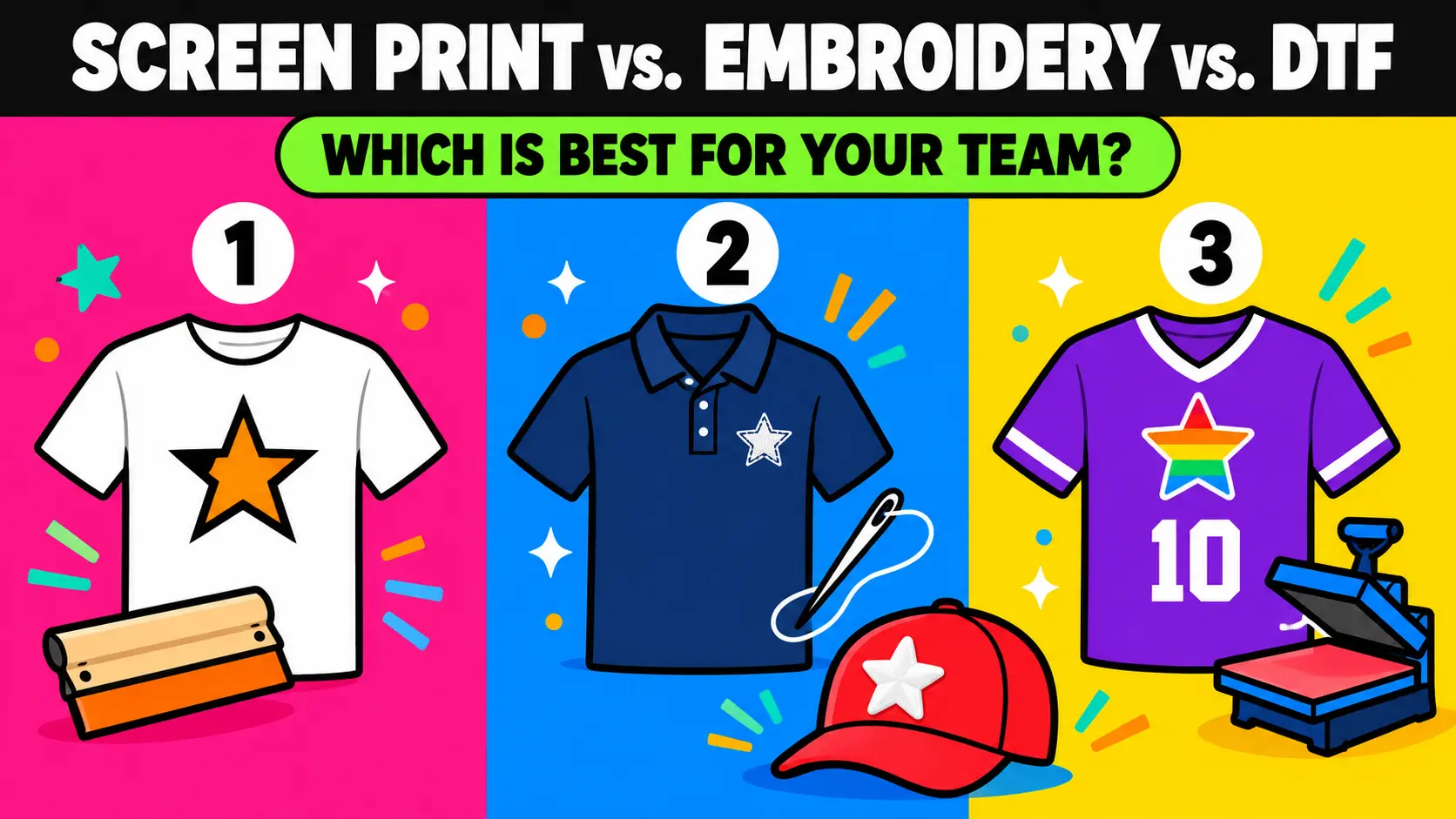
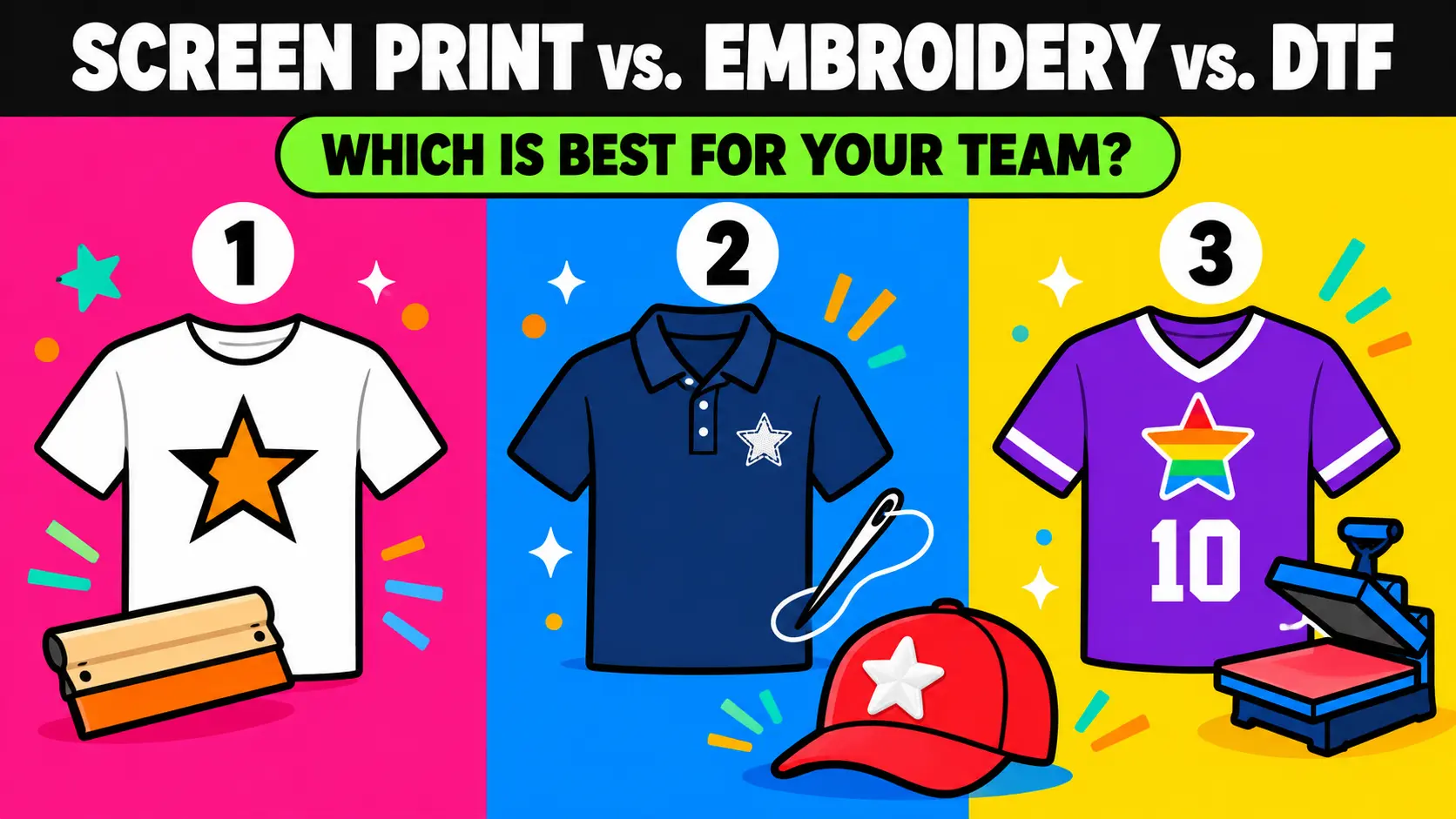
In the screen printing vs. embroidery vs. DTF decision, choose screen printing for 24 or more matching shirts with a simple 1 to 4 color design, embroidery for polos, jackets and hats that need a premium logo, and DTF for small or full-color orders with no minimums. Most teams end up mixing methods: printed shirts, DTF names and numbers, and embroidered coaches' polos and caps.
Pick the wrong one and you'll feel it. Either you pay twice as much per shirt as you needed to, or the print cracks before the season ends. Here's how to match the method to what you're decorating, how many you need and how many colors are in your design.
Screen Printing vs. Embroidery vs. DTF: What's the Difference?
Screen printing vs. embroidery vs. DTF comes down to how the design gets onto the garment, and that one difference drives cost, look and durability. Here's each method in a sentence:
- Screen printing pushes ink (usually plastisol or water-based) through a mesh screen, one screen per spot color.
- Embroidery stitches your design into the fabric with thread after it's been digitized into a stitch file.
- DTF (direct-to-film) prints your design onto a film, coats it with hot-melt adhesive powder and bonds it to the garment with a heat press.
|
|
Screen printing |
Embroidery |
DTF |
|---|---|---|---|
|
Best order size |
About 24+ pieces |
Any, often 12+ |
1 to about 50 pieces |
|
Colors |
1 to 6 spot colors typical |
Limited by thread colors |
Unlimited, including gradients |
|
Setup cost |
Per color, per location |
One-time digitizing fee |
None |
|
Wash durability |
50+ washes, often far longer |
Life of the garment |
About 50 to 100 washes |
|
Feel |
Soft, sits into the fabric |
Raised, textured |
Thin, smooth film |
|
Best garments |
Tees, hoodies |
Polos, jackets, hats, fleece |
Tees, performance wear, mixed fabrics |
The short rule: screen printing for volume, embroidery for a premium look and hats, DTF for small runs and colorful artwork.
Which Method Is Cheapest for Your Order Size?
DTF is usually cheapest for small orders, screen printing wins as quantity grows, and embroidery sits in between depending on logo size. The reason is setup cost. Each method front-loads it differently, and that decides your price per piece.
How each one is priced:
- Screen printing: a setup fee per color, per print location, commonly quoted anywhere from about $15 to $50 per screen. After that, each shirt is cheap, so bulk pricing drops fast.
- DTF printing: no screens and no setup fee. The price per piece stays roughly flat whether you order 5 or 50, often printed efficiently on a gang sheet.
- Embroidery: a one-time digitizing fee, then pricing by stitch count and location. You reuse the digitized file on every reorder.
Worked example (illustrative numbers; your quote will differ): 24 shirts with a 2-color front. Two screens at $25 each add $50, about $2 per shirt. If the print itself runs $4 a shirt, screen printing lands near $6 per shirt. At a flat $8 per DTF transfer, DTF costs more here, but at 10 shirts the screen fees would add $5 a shirt and DTF would win.
That's why the DTF vs screen printing crossover shifts. Many shops put it around 24 pieces for a simple design, but every extra color adds another screen, so a 5-color design can favor DTF well past 50 pieces. [Author: replace with your shop's real per-piece prices at 12, 24 and 72 pieces.]
Which Lasts Longest in the Wash?
Embroidery lasts longest; stitched thread won't crack, peel or fade and typically outlasts the garment. Properly cured plastisol screen prints hold up for 50+ washes and often much longer. Quality DTF transfers are commonly rated for about 50 to 100 washes.
The ranges vary because the process matters as much as the method. A screen print that wasn't fully cured, or a DTF transfer pressed at the wrong temperature, can start cracking or peeling within a few washes. Ask your shop how they test their cure.
Whatever method you choose, this routine adds seasons of life:
- Wash inside out in cold water to protect the print surface.
- Tumble dry low or hang dry. High dryer heat is the fastest way to crack prints and soften DTF adhesive.
- Skip bleach and fabric softener, which break down inks and adhesives over time.
For uniforms that go through commercial laundry, embroidery or screen printing is the safer choice.
What's Best for Team Shirts and Jerseys?
For custom team shirts in quantity, screen printing is the best value; for small rosters, full-color logos or polyester jerseys, DTF is usually the better pick. The deciding factors are roster size, color count and fabric.
- 24+ matching cotton or 50/50 blend tees (Gildan, Bella+Canvas or Next Level, for example): screen printing.
- Under about 24 shirts, or a logo with gradients and photo-quality detail: DTF.
- Polyester performance shirts and moisture-wicking, dri-fit style jerseys (such as Sport-Tek): DTF handles poly easily. Screen printing works too, but it needs a low-cure ink and a dye-blocking underbase to stop dye migration, where the fabric's color bleeds into the ink.
- All-over designs on white polyester: sublimation dyes the fabric itself, so there's no print to crack and breathability stays high.
How Do You Add Individual Names and Numbers?
Use DTF or heat-transfer vinyl (HTV) for names and numbers, applied on top of the main design. Every jersey is different, so screen printing each name would mean a new screen per player. That's slow and expensive. The usual workflow:
- Print the shared team design on every shirt with screen printing or DTF.
- Heat-press each player's name across the back with DTF or HTV.
- Add the numbers the same way, sized to your league's rules.
[Author: add a real team order that combined methods, such as screen-printed fronts, DTF names and embroidered coaches' caps.]
What's Best for Work Uniforms and Polos?
Embroidery is the best choice for work uniforms and company polos. It looks professional, survives frequent and commercial laundering, and never cracks or peels. In the screen printing vs embroidery choice for staff apparel, embroidery wins on everything except large designs.
- Pique polos, button-downs and softshell jackets (Port Authority, for example): embroidered left-chest logo, typically about 3.5" to 4" wide.
- Fleece hoodies, and especially sherpa or high-pile fleece: embroidery. Ink can't print cleanly on deep pile.
- Staff T-shirts with a large back print: screen printing or DTF, with an embroidered left-chest logo on the front if you want both.
One limit to plan around: text shorter than about 0.25" won't stitch cleanly. If your logo has a tiny tagline, drop it from the embroidered version or make it larger.
Should You Embroider, Print or Patch a Hat?
Embroidery is the standard for custom hats, especially structured caps. Thread holds its shape on a stiff, curved front panel, where ink and transfers struggle. Screen printing is rarely used on hats for that reason.
Your options, and when each one fits:
- Flat embroidery: the default for structured caps, trucker hats (like the Richardson 112), snapbacks, fitted caps (like Flexfit) and beanies.
- 3D puff embroidery: a raised foam base under the stitching for bold, chunky logos on the front of a structured cap.
- Patches: embroidered, woven, leather or PVC patches give a premium look. Patches are also easy to reorder, since the patch design stays the same.
- DTF with a cap press: works for full-color logos on flatter panels and unstructured dad hats, though embroidery holds up better with daily wear.
If your logo has fine detail or gradients that won't stitch well, a woven patch keeps the detail and still looks like a finished, premium hat.
The Bottom Line
In the screen printing vs. embroidery vs. DTF decision, the garment usually picks the method for you:
- Team shirts: screen printing for 24+ matching shirts, DTF for small rosters, full-color art and names and numbers.
- Work uniforms: embroidery for polos, jackets and fleece.
- Hats: embroidery or patches, with DTF for full-color logos on flatter caps.
Not sure which fits your order? Send us your design, quantity and garments, and we'll get you a free mockup with pricing for each method side by side.
About the author: [Author Name] is [role] at [Business Name], with [X] years of experience producing screen-printed, embroidered and DTF apparel for sports teams, schools and local businesses.
Meta description (under 155 characters): Screen printing vs. embroidery vs. DTF: compare cost, minimums and durability to pick the right method for team shirts, uniforms and hats.